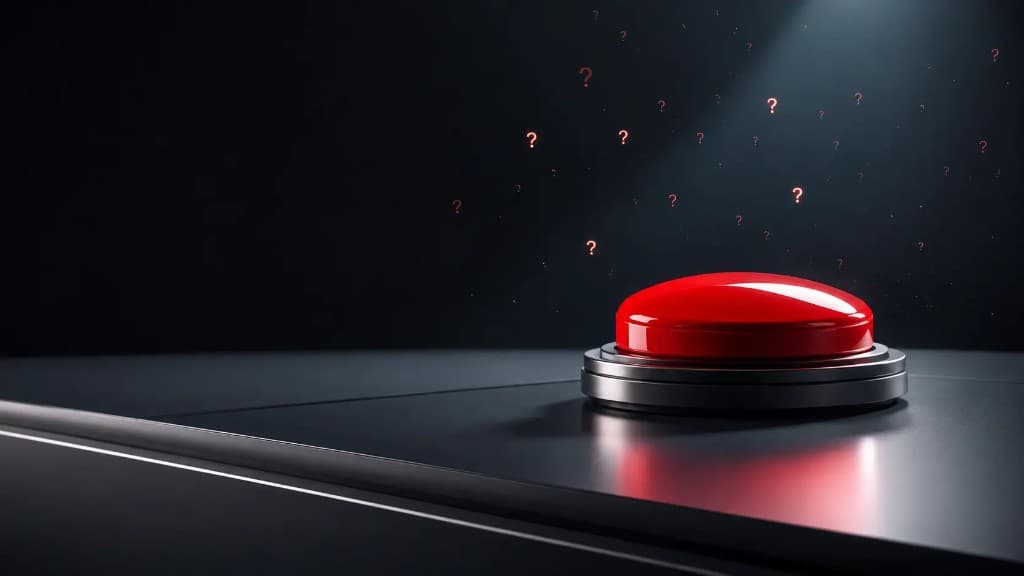
There are a lot of things you can buy on the internet. You can buy a new laptop. You can buy shoes. You can buy a coffee machine that somehow has Wi-Fi. You can buy a tiny refrigerator for your bedroom that exists almost exclusively to cool six cans of Coke.
And then there is the much stranger category of internet purchases: buying a button.
Not a keyboard. Not a controller. Not some complicated smart-home device with seventeen different settings. A button. A physical object whose entire appeal begins with one incredibly simple question: “What happens if I press it?”
That question is precisely what makes buttons so strangely compelling.
Why Are Buttons So Tempting?
Think about the last time you saw a large red button with a sign saying DO NOT PRESS. Be honest. Did you immediately want to press it? Of course you did.
The instruction itself creates the temptation. A button isn't particularly interesting when you are allowed to press it. Your television remote has buttons. Your keyboard has buttons. Your elevator has buttons. You press them hundreds of times without thinking.
But put a giant button in front of someone and tell them not to touch it? Suddenly it becomes the most important object in the room. That's the basic psychological trick behind the entire “don't press the button” concept. The less information you provide about what happens next, the more powerful curiosity becomes.
The Mystery Is the Product
This is what makes a novelty button different from an ordinary object. You're not really buying plastic, electronics, metal or a switch. You're buying the joke. You're buying the story. You're buying the opportunity to put an absurd object on your desk and wait for someone to ask: “What's that?”
And then you get to give them the only answer that matters: “Don't press it.” At that point, you've created a tiny psychological experiment. And almost everyone wants to participate.
Why Owning a Button Is Weirdly Fun
The internet has made it incredibly easy to buy useful things. That's exactly why useless things can be so entertaining. A novelty purchase doesn't need to solve a problem. It can simply create a moment.
A funny object sitting on your desk can become an icebreaker during a video call. A strange button can become a conversation starter at work. It can sit next to your monitor for months, waiting for somebody new to notice it. On the web, you can even own your own button — a live page where the whole joke plays out in public and every visitor sees who holds it.
The object doesn't need to be practical. Its job is to make people curious. And curiosity is surprisingly valuable.
The Psychology of “Don't”
There is a fascinating reason the phrase “don't” works so well. When someone tells you not to do something, your brain immediately starts considering the forbidden action. “Don't look.” You want to look. “Don't open this.” You want to open it. “Don't press this button.” You suddenly need to know what pressing it does.
The button doesn't even have to promise a reward. The uncertainty itself is enough. That's why the phrase has become such a powerful internet meme and recurring concept. Games use it. Websites use it. Videos use it. Books use it. And novelty products can turn the same psychological mechanism into something physical — or digital.
A Button Is Also a Social Experiment
Imagine putting a mysterious button on your desk. You don't explain it. You don't demonstrate it. You simply leave it there. Eventually someone will notice. “What does that do?” You shrug. “I don't know.” “Have you pressed it?” “No.” “Why not?” “Because it says don't.”
At this point, you've successfully created a social experiment using approximately one object and six words. People will start debating whether they should press it. Somebody will eventually reach toward it. Someone else will stop them. And someone will probably press it anyway. That's the beauty of a good novelty object. It doesn't require an instruction manual. It creates its own interaction.
Why People Buy Weird Things Online
There is another reason products like this work particularly well on the internet. People don't always shop online because they need something. Sometimes they are looking for something that makes them laugh. Search engines are full of queries that reveal this behavior: “weird things to buy online,” “funny desk gadgets,” “unique gifts,” “things nobody needs,” “funny gifts for friends,” “strange products.”
These searches aren't necessarily driven by utility. They're driven by discovery. People want to find something they've never seen before. And that makes unusual products incredibly shareable.
The Perfect Gift for Someone Who Has Everything
The hardest person to buy a gift for is usually the person who already owns everything they actually need. They don't need another wallet. They don't need another mug. They probably don't need another pair of socks. But give them something completely ridiculous? That's different.
A novelty button can work because the gift isn't really the object. It's the reaction. The recipient opens the package. They see the button. They read the warning. They laugh. Then they immediately want to press it. That's a much more memorable experience than another generic item pulled from a “top 20 gifts” list.
The Internet Has Made Weird Purchases Normal
Twenty years ago, buying something this strange might have required finding a novelty shop. Today, the internet has created an entire economy around objects that exist primarily to entertain. People buy desk toys. Miniature gadgets. Ridiculous kitchen tools. Strange lamps. Interactive toys. Novelty signs. And objects whose entire purpose is to make somebody say: “Why does this exist?”
That's not necessarily a criticism. Sometimes that's exactly why something exists.
So… Should You Buy a Button?
That's the wrong question. The better question is:
What would happen if you owned one?
Would your friends press it? Would your coworkers press it? Would you put it beside your monitor? Would you give it to someone who has absolutely no self-control? Would you leave it somewhere and watch people slowly become obsessed with figuring out what it does?
That's where the fun begins. The internet is already full of things designed to be useful. Every once in a while, it's refreshing to own something whose only real purpose is to make people curious. And if you've reached this point in the article, there's a fairly good chance you're already wondering what the button looks like. That's probably not an accident.
Just don't press it.
Or, more accurately… you know what to do.
Frequently asked questions
15 answers
Ready to test your self-control? You can see the button for yourself — pay to hold it, add your link, and lose it only when someone outbids you. Entertainment only. No cash prizes.
Go to the button →