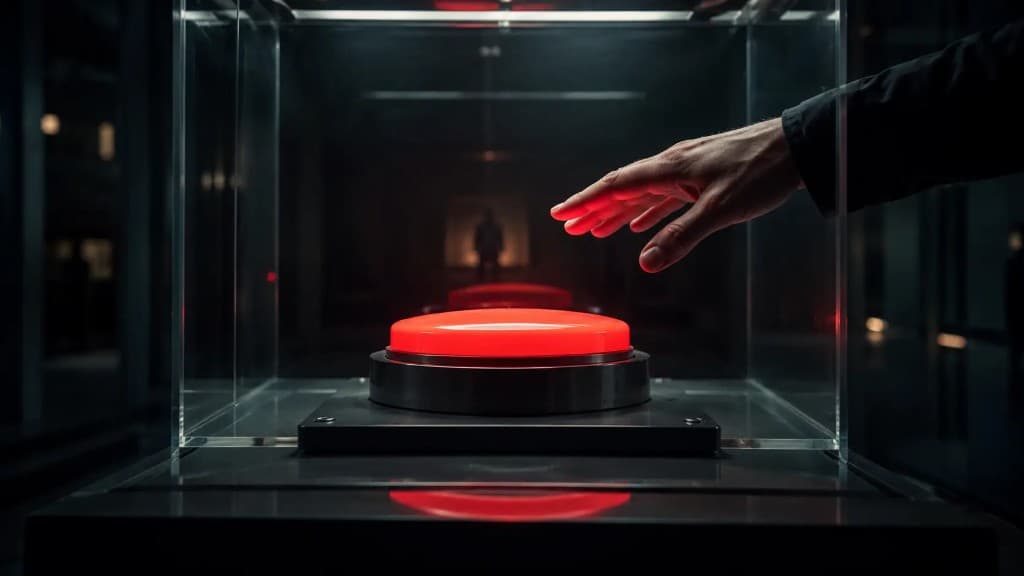
There are few instructions more powerful than: DO NOT PRESS.
Not because the words are complicated. They're not. In fact, they're incredibly simple. But put those words above a large, mysterious button and something strange happens.
Your brain immediately starts asking questions.
Why can't I press it? What happens if I do? Who put this here? What happens if nobody is watching? Is it actually dangerous?
And eventually, the most dangerous question of all appears: “What if I just press it once?”
That tiny sentence explains a surprisingly large amount about human curiosity.
The Button Isn't Interesting Until You Tell Us Not to Touch It
A normal button is boring. Your keyboard has dozens of them. Your phone has buttons. Your car has buttons. Your microwave has buttons. You interact with them constantly without thinking.
But change the instruction and everything changes. Instead of PRESS, you write DO NOT PRESS. Now the button has a story. There is something you're not supposed to know. And humans are exceptionally bad at ignoring unanswered questions.
Curiosity Loves Missing Information
Imagine someone tells you: “I know a secret.” Then they refuse to tell you what it is. You immediately want to know. The secret could be completely irrelevant. It doesn't matter. The missing information itself creates tension.
A forbidden button works in exactly the same way. The button doesn't tell you what happens. It creates an information gap. Your brain wants to close it. Pressing the button appears to offer a way to do that.
The Forbidden Makes It More Valuable
There's a reason advertisements use phrases such as: “Don't look.” “Don't open this.” “Don't watch until the end.” “Whatever you do, don't click.” They're all variations of the same psychological mechanism.
The restriction becomes part of the attraction. If there were nothing interesting behind the instruction, there would be no reason to forbid the action. At least, that's what your brain assumes. And that's enough to make you curious.
You can experience the idea yourself — a live page built entirely around that forbidden-action tension, where every visitor faces the same impossible instruction.
What Happens When Someone Gives You a Rule?
Rules normally make life easier. Don't touch a hot stove. Don't cross the road without looking. Don't open somebody else's mail. But a rule can also create a challenge — especially when the consequence isn't clear.
A mysterious “don't press” instruction feels less like safety advice and more like a dare. And humans love dares.
The Button Becomes a Test
At some point, the question stops being: “What happens if I press it?” It becomes: “Can I resist pressing it?”
Now the button is testing your self-control. That's much more interesting. You're no longer interacting with an object. You're interacting with yourself. You are measuring curiosity against restraint. And suddenly a piece of plastic — or a pixel on a screen — can become a tiny psychological experiment.
Uncertainty Is the Secret Ingredient
If a button said: “Press me to turn on your desk lamp,” there wouldn't be much mystery. You already know what happens. Press. Lamp turns on. Done.
But imagine the button says nothing. No explanation. No instructions beyond: DON'T PRESS. Now the possible outcomes become unlimited. Maybe it plays a sound. Maybe it changes something. Maybe absolutely nothing happens. Maybe something hilarious happens. You don't know. That uncertainty is precisely what makes the interaction compelling.
Why the Internet Loves the Concept
The internet is basically a giant curiosity machine. Every link leads somewhere. Every notification contains something. Every thumbnail suggests information. Every headline promises an answer. The “don't press the button” concept fits perfectly into that environment.
It's an interaction built around curiosity. You see something. You're given a restriction. You become curious. You interact. You discover the result. It's almost the perfect miniature internet experience — which is why the interactive button experiment has become such a compelling live spectacle.
This Is Why Interactive Websites Work
A traditional article gives you information. An interactive website gives you something to do. That's a fundamentally different experience. You aren't just reading about a button. You're interacting with one.
That small difference can completely change how memorable the experience becomes. The best interactive websites understand this. They don't necessarily need hundreds of features. They need one compelling interaction.
The Button as a Social Experiment
Put the button in a room with ten people. Tell everyone not to press it. Now watch what happens. One person will immediately approach it. Another person will say: “Don't.” Someone else will ask: “Why?” Another person will start making theories. Eventually somebody will probably press it. And everyone will look at them.
The button has now created a social event. It didn't need an elaborate game. It didn't need a complicated interface. It simply created uncertainty.
Why We Press Things We Shouldn't
There isn't one single reason humans give in to curiosity. Sometimes it's the desire for information. Sometimes it's the thrill of breaking a rule. Sometimes it's boredom. Sometimes it's social pressure. Sometimes it's simply because we want to see what happens.
And sometimes… we're just terrible at leaving mysterious buttons alone.
The “Just One Press” Problem
The most dangerous phrase around a button is: “Just once.” Because once you've pressed it, the mystery disappears. Or does it?
If the button produces a surprising response, you might want to press it again. Then again. Then again. A simple interaction can become a loop. Action. Reaction. Action. Reaction. That's one reason interactive experiences can be so engaging.
Curiosity Is Not a Bad Thing
It's easy to describe curiosity as something that gets us into trouble. But curiosity is also one of the things that drives discovery. Scientists ask questions. Developers experiment. Artists explore ideas. Children touch everything. Curiosity pushes people toward information they didn't have before.
The problem isn't curiosity. The problem is occasionally applying it to something that very clearly says: DO NOT PRESS.
So What Would You Do?
Imagine you're standing in front of a mysterious button. There's no explanation. No instructions. Just one sentence: DON'T PRESS THE BUTTON.
Would you walk away? Would you stare at it? Would you ask someone else to press it? Would you record yourself pressing it? Or would you eventually give in?
That's the entire appeal. The button isn't really testing your finger. It's testing your curiosity. And if you want to see just how difficult it is to ignore that temptation, there's an interactive version of the idea waiting for you online.
Just remember one thing. You were told not to press it.
Frequently asked questions
21 answers
Curiosity won't press itself. You can see what happens when curiosity wins — pay to hold the button, add your link, and lose it only when someone outbids you. Entertainment only. No cash prizes.
Go to the button →